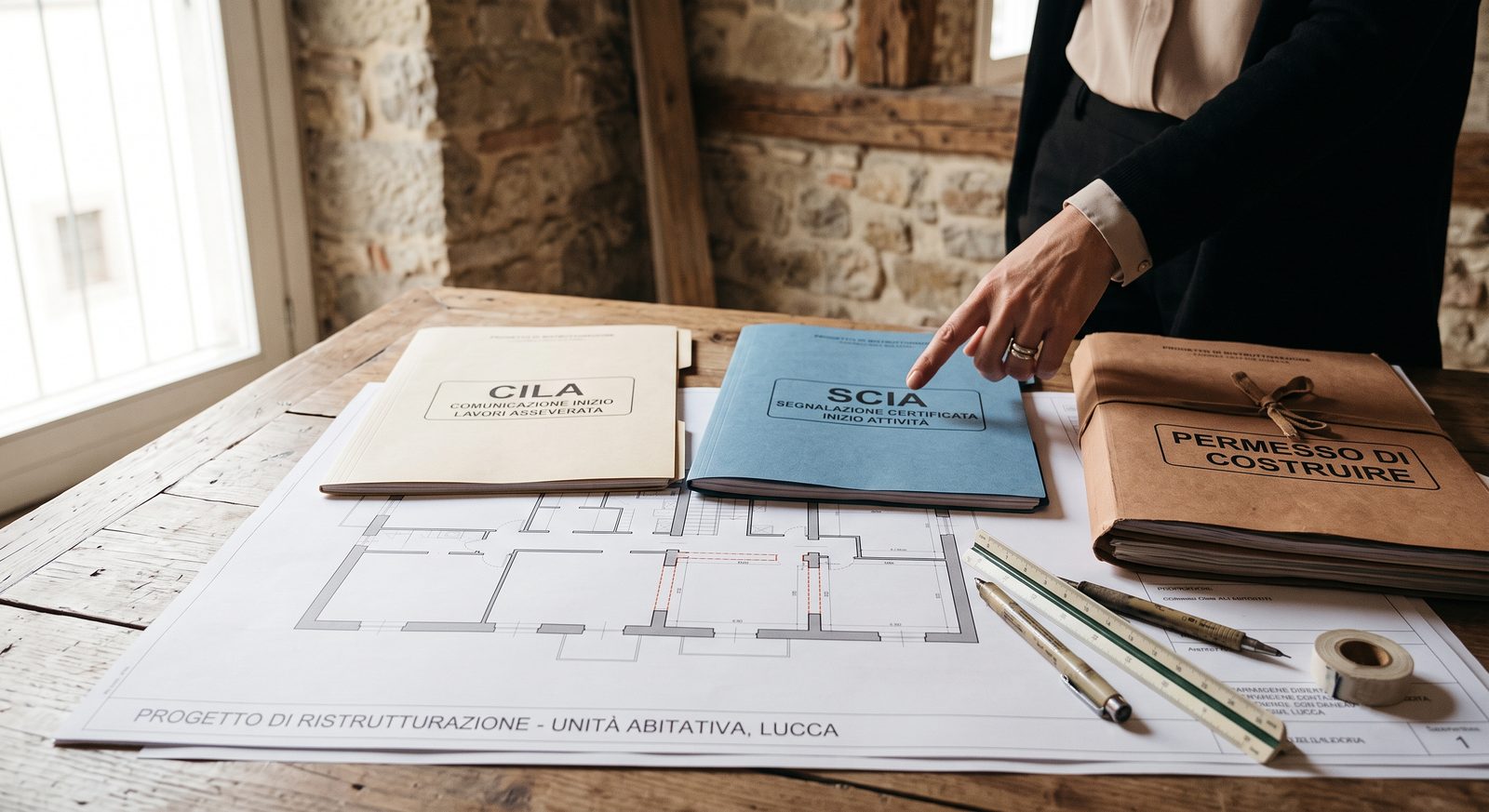
You've decided to renovate and you've been told you "need the paperwork". But which? CILA, SCIA, building permit: acronyms that all look the same but that actually change the timing, cost and risk of your site. Getting the building title wrong — or worse, starting without one — can halt the works, void the bonuses and turn into a fine.
In this guide I'll explain, in plain terms and with concrete examples, which one you need for what. Whether you're doing up an apartment in the Piana di Lucca or a villa in Versilia.
A note for international readers: CILA, SCIA and "permesso di costruire" are the three main building titles under Italian law (the Building Code, D.P.R. 380/2001). We keep the Italian names — they're what you'll see on every document and quote — and explain each in plain English.
First rule: it depends on the works, not the square metres
The building title isn't chosen by feel, nor by how much you spend: it depends on the type of work and on how much it "affects" the property and the surrounding area. The reference legislation is the Building Code (D.P.R. 380/2001). Simplifying, the works sit on a ladder, from the lightest to the most demanding — and each rung has a different title:
- Building-free works (edilizia libera) — no paperwork.
- CILA — extraordinary maintenance that doesn't touch the structures.
- SCIA — works on the structures or more substantial alterations.
- Building permit (permesso di costruire, or the SCIA alternative) — the most significant works.
Building-free works: when no paperwork is needed
Some works can be done without filing anything at the Municipality (edilizia libera). This includes, for example, ordinary maintenance (repainting, replacing floors and tiling, repairing systems), replacing sanitary ware, many works to remove architectural barriers, awnings and pergolas within certain limits.
Beware, though: "no paperwork" doesn't mean "no rules". The works must still comply with technical and safety standards and, where present, with the constraints. And in some cases a cadastral update is still required.
CILA: extraordinary maintenance that doesn't touch the structures
The CILA (Certified Notice of Commencement of Works) is the most common title in interior renovations. It's used for extraordinary maintenance that doesn't affect the structural parts of the building. Some typical examples:
- moving or removing non-load-bearing partitions and reworking the internal layout;
- completely refitting a bathroom or the kitchen;
- renewing the systems (electrical, plumbing, heating);
- replacing windows and doors, within the set limits.
How it works: a qualified professional (a surveyor, architect or engineer) prepares and certifies the filing; once it's submitted, the works can start straight away, without waiting for an authorisation. It's not a free-for-all, though: it requires a check of the property's legitimate state (we'll come to that shortly) and compliance with any constraints.
SCIA: when you touch the structures or change the building's makeup
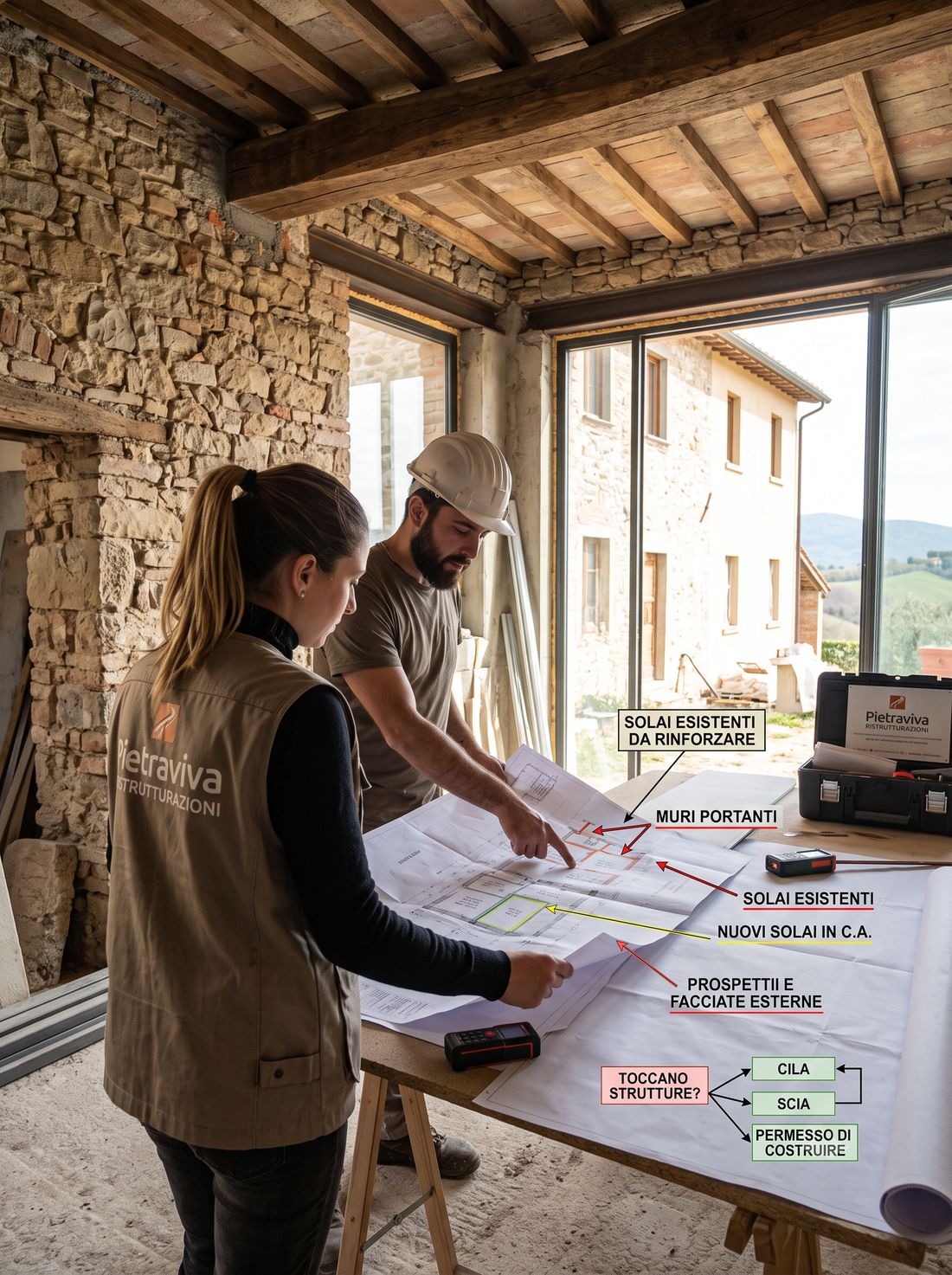
You go up a rung when the works affect the structural parts or alter the property more substantially. Here you need a SCIA (Certified Notice of Commencement of Activity). Some examples:
- opening a gap in a load-bearing wall or altering its layout;
- working on floor slabs, beams or other structures;
- a conservative restoration that touches the structures;
- some "light" renovations.
The SCIA requires a fuller design, often accompanied by structural calculations and filing with the relevant office: in a seismic zone this is a delicate step, not to be underestimated. Even with a SCIA, as a rule, the works can start from the moment of filing — but the technical side is more demanding and must be done properly.
Building permit (and the SCIA alternative): the most demanding works
For the most significant works you need the building permit (permesso di costruire): new constructions, extensions adding new volume, "heavy" renovations that lead to a building that's wholly or partly different (with changes to shape, elevations or volumes, especially in constrained areas), urban restructuring.
Unlike the CILA and SCIA, the permit must be requested and obtained from the Municipality before starting: there's an assessment and waiting times to factor in. In many of these cases the law allows, as an alternative, the so-called "SCIA alternative to the building permit" (super SCIA), with broader procedures and professional responsibilities. Which of the two routes is preferable is assessed case by case.
How to work out which one: the right questions
To get your bearings, before anything else, ask yourself these questions:
- Am I touching the structures? (load-bearing walls, floor slabs, beams) If yes, you move up towards a SCIA.
- Am I changing volumes, shape or elevations? If yes, you move towards a building permit or the SCIA alternative.
- Am I changing the use classification? (for example from storage to dwelling) This is a type of work that often requires a specific title and planning checks.
- Is the property constrained or in a historic centre? Additional authorisations are needed, such as landscape authorisation or the opinion of the Heritage Office (Soprintendenza).
The answers aren't always clear-cut, and a single site often combines several kinds of work. That's why the classification is done by the professional, after an inspection and a review of the documents: it's what turns a doubt into a clear path, with predictable timing and costs.
The precondition for everything: the legitimate state
There's a step that comes before choosing the title: checking that the property is in order "on paper". If the actual state doesn't match the past building titles or the cadastral floor plan, the new filing can stall or turn out to be irregular. We covered this in detail in the guide on cadastral compliance and Salva Casa. In practice: first you sort out the past, then you file the title for the new works.
The same goes for incentives: as we explain in the guide on how to renovate a house in 2026, to access the bonuses the technical side must be in order before opening the site.
In Lucca and Versilia: historic centres and constraints
In our area, choosing the title is often intertwined with constraints. In the historic centre of Lucca, on period residences and across large parts of Versilia, many works require — on top of the building title — a landscape authorisation or the opinion of the Heritage Office. The timing and the required documents change.
Knowing the local regulations and offices is exactly what makes timelines truly predictable: it's the difference between a filing that flows and one that gets stuck.
Frequently asked questions
Usually yes: with a CILA and a SCIA the works can begin from the date the notification is filed. A building permit, on the other hand, must be requested and obtained from the Municipality before starting. In any case, constraints and any additional authorisations (such as landscape authorisation) must be respected.
In short: the CILA covers extraordinary maintenance that doesn't touch the structural parts of the building (for example moving non-load-bearing partitions or refitting a bathroom). The SCIA is needed when you work on the structures or alter the property more substantially, with a fuller design and often structural calculations.
Fines, possible suspension of the works, difficulties when selling and the loss of tax bonuses. Many situations can be regularised, but doing it afterwards costs more and takes longer: it's better to start with the correct title.
A qualified professional (a surveyor, architect or engineer) after an inspection and a review of the property's documents. It's the professional who classifies the works, chooses the title and certifies the filing.
Have a question about this article?
Message us on WhatsApp: a surveyor replies directly, no obligation. Or fill in the form.
Not sure which permit your works need?
With Pietraviva a professional checks your property, classifies the works and prepares the right title — no wrong filings and no surprises once the site is open. A single technical point of contact from design to the keys.
The information provided is current as of July 2026 and is indicative and informational only: it does not replace the assessment of a qualified professional. The classification of the works and the correct building title must be defined case by case, based on the state of the site and the municipal regulations in force.