You've found the right house to renovate: an apartment in the historic centre of Lucca, a country house in the Piana, a rustic to recover. The price looks attractive and the idea excites you. But there's one question worth more than any other: is that house really what it seems?
Buying a property to renovate is one of the most rewarding operations in our area — provided you know exactly what you're buying and what it will cost to bring it back to life. Surprises, when they come, almost always come after the deed: when the house is already yours, and so are the problems. In this guide we look at the checks to do before signing, while you still have the upper hand.
A note for international buyers: in Italy the purchase is finalised before a notary with the "rogito" (the notarial deed of sale), usually preceded by a "preliminare" (preliminary contract, or compromesso). The checks below are best completed before either signature.
Why the checks should be done before the deed, not after
This is the point that changes everything. Until you've signed, you have bargaining power: you can negotiate the price, ask the seller to fix a discrepancy, add clauses to protect yourself or, in the worst cases, walk away. After the deed, all of this disappears: the problems become yours, along with the cost of solving them.
The ideal moment for the checks is before the purchase offer or, at the latest, before the preliminary contract. If you've already signed an offer, you can still add conditions precedent tying the purchase to the outcome of the technical checks. The goal is one only: to arrive at the notary's with the full picture, not with your fingers crossed.
1. Building and cadastral compliance
It's the most important check, and the most underestimated. The house must be in order "on paper": the floor plan filed with the Land Registry must match the actual state, and what exists today must be covered by the building titles issued over time (the so-called legitimate state). A moved window, a mezzanine never declared, an extension built decades ago can halt the deed, complicate the mortgage or void the bonuses.
We've devoted a full guide to this topic: cadastral compliance and Salva Casa — what to check before selling, buying or renovating. The point for a buyer is simple: discrepancies must be found first, so you can estimate the cost of regularising them and use it in the negotiation — not suffered afterwards.
2. Constraints, historic centre and what you can (really) do
In Lucca, location counts double. In the historic centre, on period properties and in many parts of Versilia, works may require a landscape authorisation or the opinion of the Heritage Office. Before buying, it's worth understanding what will actually be possible: opening that gap, moving that staircase, changing the use classification.
It's also the moment to check which building title your intended works will need — CILA, SCIA or building permit — because it affects timing and costs. We cover this in the guide CILA, SCIA or building permit: which one you need for your renovation.
3. How much it will really cost to renovate
The purchase price is only half of the operation. The other half is the recovery cost, and this is where many "bargains" turn out to be bargains only on paper. Before signing you need a realistic estimate of the works: systems, structures, bathrooms, finishes, plus the technical side and any regularisations.
To get your bearings on cost per square metre and on what weighs most on the budget, you'll find updated benchmarks in the guide Renovating a house in Tuscany in 2026: the 50% bonus, real costs and what changes from 2027. The golden rule: add the purchase price and the recovery cost before deciding, not once the site has started.
4. Structures, systems and actual condition
Beyond the paperwork, the actual state matters. A technical inspection reads what a "buyer's viewing" doesn't catch:
- Structures and safety. Masonry, floor slabs, roof, any cracks or subsidence. In a seismic zone it's a delicate chapter that can weigh heavily on the budget.
- Damp and roofing. Infiltrations, rising damp, condition of the roof and gutters: frequent problems in rustics and older properties.
- Systems. Electrical, plumbing, heating: almost always to be redone in properties to renovate, and a significant item.
- Energy rating. An energy-hungry property affects future costs and the scale of the work.
5. Mortgages, title history and boundaries: the technical-notarial side
Some checks concern the property's "history" and must be coordinated with the notary. Before the deed it's wise to verify that there are no mortgages or attachments, that the title history is sound (gifts and inheritances deserve attention), and that boundaries, shares and easements match what's declared. These are matters that, if they emerge later, complicate life considerably.
The Pietraviva pre-purchase service
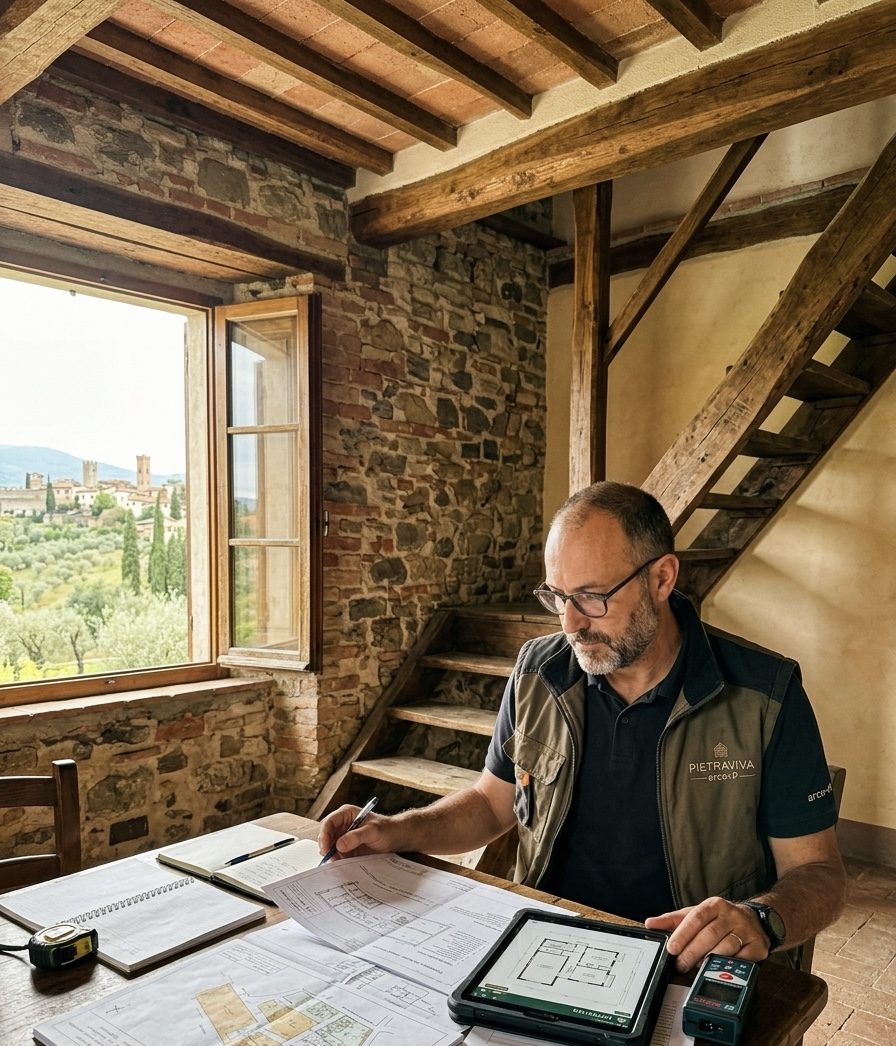
This is exactly the point where we step in. Behind Pietraviva there's a technical studio: before you sign, a professional who answers to you — not to the seller, not to the agency — checks the property and hands you a clear picture. In practice:
- Document review of building and cadastral compliance, legitimate state and constraints.
- Technical inspection of structures, systems and actual condition.
- Estimate of recovery costs and of any regularisations, so you know what the operation will really cost.
- Support in the negotiation: you use the numbers to negotiate the price or the protections, with the data in hand.
You know what you're buying before signing at the notary's. And if you then decide to renovate, you already have your single technical point of contact, from design to the keys.
In Lucca and Versilia: why knowing the area matters
Municipal regulations, offices, historic-centre constraints, local practice: they change from area to area. Working where we know the territory — the Piana di Lucca and Versilia — is what makes the checks fast and the timelines predictable. It's the difference between a purchase that flows and one that gets complicated.
Frequently asked questions
As early as possible: ideally before signing the offer or the preliminary contract. If you've already signed, clauses can be added that make the purchase conditional on the outcome of the checks. The aim is to reach the deed knowing exactly what you're buying and what it will cost to fix.
Yes, but you need to know beforehand. Many discrepancies can be regularised; what matters is knowing about them and estimating the cost of regularisation, so you can negotiate the price or add the right protections to the deed. Discovering them after the deed means facing them on your own.
A qualified professional (a surveyor, architect or engineer), ideally independent of the seller and of whoever will carry out the works. They check compliance, the legitimate state, constraints and the property's actual condition, and estimate the recovery costs.
A first picture takes just a few days: you retrieve the documents (registry searches, building titles, cadastral floor plan), carry out an inspection and put in writing what's in order, what needs fixing and at what indicative cost.
Have a question about this article?
Message us on WhatsApp: a surveyor replies directly, no obligation. Or fill in the form.
About to buy a house to renovate in Lucca or Versilia?
With Pietraviva a professional checks the property before the deed: compliance, constraints, actual condition and an estimate of the recovery costs. You sign knowing what you're really buying — not the firm that sells you the works, the professional who protects you.
The information provided is current as of July 2026 and is indicative and informational only: it does not replace the assessment of a qualified professional and of the notary. Every property must be checked case by case, based on the state of the site, the documents and the regulations in force.